Ethical SEO with Clean DoFollow Backlinks
Secure safe dofollow links by embedding contextually relevant anchors in-body on high‑trust, indexed pages with consistent organic traffic. Give priority to topical alignment and intent match over raw authority; work toward a natural anchor mix (50–70% branded plus URL, 20–35% partial, <10% exact). Evaluate publishers for editorial standards, HTTPS, Core Web Vitals, and clean outbound patterns. Avoid paid/exchange footprints; read more track link velocity, toxicity, and anchor drift. Assess impact via GSC impressions, referral and assisted conversions, and ranking shifts—more elements boost performance.
Main Points
What Defines a DoFollow Link “safe” in 2025
As Google’s link signals progress, a DoFollow link is deemed secure in 2025 when it is contextually relevant, obtained from quality pages, and aligned with documented guidelines. You should confirm link provenance: verify the source page is indexed, attracts organic traffic, and sits in a topical neighborhood matching your content. Review on-page placement; in-content links surpass footer/sidebar placements. Use anchor diversity to diminish manipulation signals—mix exact, partial, branded, and URL anchors according to intent.
Assess outgoing link patterns to prevent association with spam-adjacent environments. Confirm the referring page loads swiftly, avoids being ad-saturated, and uses clean HTML without disruptive scripts. Ensure the link avoids being purchase-based or reciprocal without proper rel attributes. Watch post-acquisition metrics—referred visitors, assisted conversions, and indexation—to validate ongoing reliability.
Assessing Domain Trust: Metrics That Truly Matter
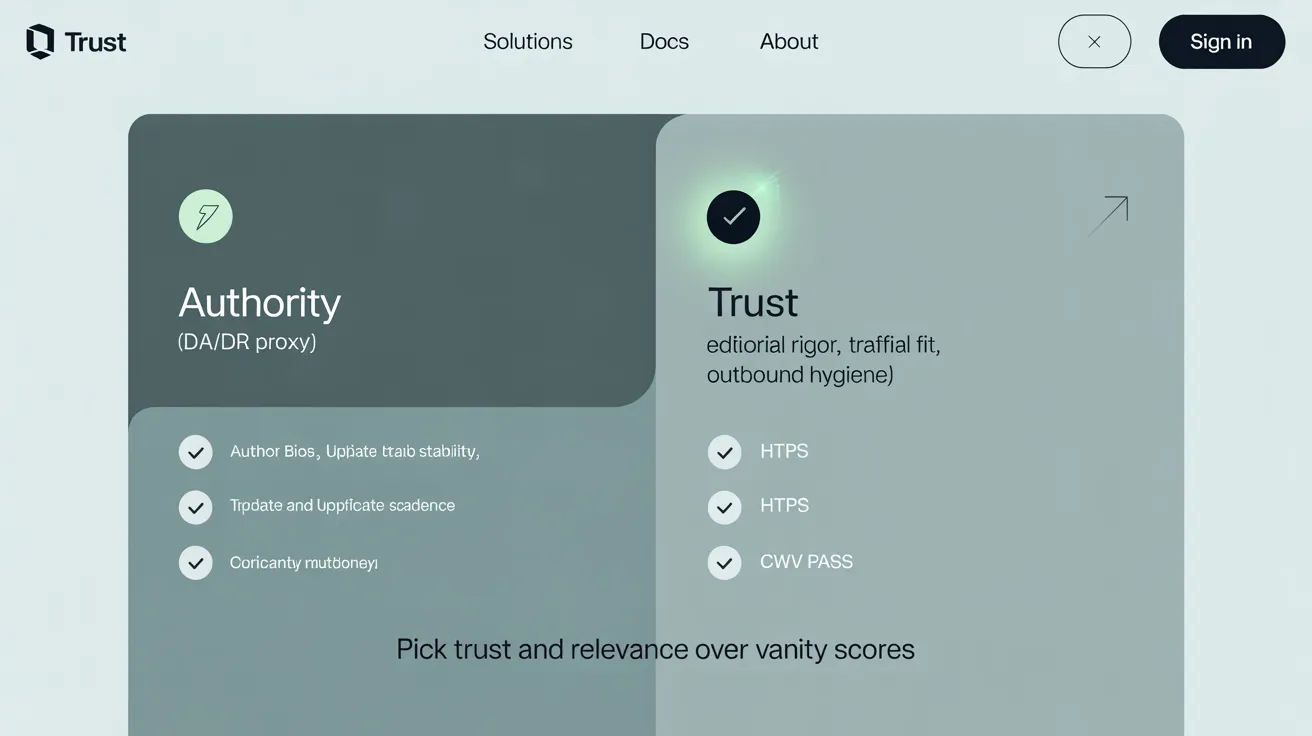
You should separate Domain Authority from Trust by linking DA with link equity and Trust with validated publisher quality, entity signals, and editorial standards. Quantify spam signals and toxicity using metrics like outbound link ratio, anchor-text entropy, link velocity anomalies, malware/phishing flags, and historical disavow prevalence. Give preference to domains with high Trust indicators and low toxicity scores, even when DA seems attractive.
Comparing Domain Authority and Trust
While DA and DR can assess a domain's relative strength, they are approximations—not trust. You must not chase high Domain Authority alone; you should examine whether links pass real authority signals and visitor-facing credibility. Trust originates from source quality, topical alignment, link placement, and historical reliability. Evaluate backlink source relevance, editorial context, crawl frequency, and index longevity to identify trust decay over time.
Measure using combined metrics: branded anchor ratios, linking speed steadiness, content freshness, and internal connection logic. Confirm through display counts, SERP movement, and assisted conversions to establish link-driven impact. Evaluate author background, publishing guidelines, and outgoing link integrity to confirm intent. Emphasize domains with consistent rankings, steady natural visitors, and verifiable audiences. When you build DoFollow links, pick partners where trust indicators exceeds cosmetic authority scores.
Spam Signals and Toxicity
As trust erodes where manipulation infiltrates, detect spam signals with definable thresholds and root-cause patterns. Flag outliers: >20% exact-match anchors, >10:1 follow-to-nofollow ratio, or sudden 5x link velocity spikes. Review TLD mix; low-cost ccTLD clusters often indicate link poisoning. Monitor IP/subnet diversity;
Assess content-context alignment via topical TF-IDF overlap; a 40% shared targets suggest ring behavior. Test network resilience by eliminating top referrers; unstable rankings show dependency. Disavow systematically, replace with contextually relevant and authoritative citations, and re-crawl to confirm recovery.
Relevance Versus Raw Domain Power: Harmonizing Topics and Intent
Begin by focusing on topical alignment first—align referring page themes to your target keywords to enhance semantic relevance and decrease noise. Apply intent-mirroring anchor text (navigational, transactional, informational) ensuring query intent, anchor phrasing, and landing page content form a clean triad. Place links contextually within high-signal sections (body content near relevant entities, avoiding footers and sidebars) to increase CTR, passage-level relevance, and ranking impact.
Content Alignment Priority
Despite the fact that elevated Domain Rating may be tempting, prioritize topical alignment: a dofollow link from a semantically related page that corresponds to your search intent (informational, conversion-focused, commercial) delivers stronger relevance signals, higher link equity transfer, and improved ranking correlations. You’ll get more impact when the referring page resides in coherent topic clusters and supports your target URL’s semantic mapping. Identify entities, subtopics, and co-occurring terms to ensure lexical overlap and contextual consistency.
Assess prospects through topical proximity measurement: analyze n-gram overlap, TF‑IDF vectors, and category tags. Confirm through SERP co-occurrence and internal link graphs. Focus on pages that rank for related queries and share schema types, product categories, or problem-solution frameworks. When you match content scope and search intent, you minimize noise, centralize PageRank, and secure more stable positions across related keywords.
Intent-Matching Link Text
When anchor text aligns with the searcher’s intent, you enhance topical relevance signals and increase CTR and rank stability beyond what raw authority alone can achieve. Align anchors to search intent tiers: informational (“how to fix 404 errors”), commercial investigation (“best log analyzers”), transactional (“buy SSL certificate”), and navigational (“Semrush Site Audit”). Use SERP analysis to infer query intent: compare the top 10 titles, SERP features, and content types; then sync anchors accordingly.
Focus on exact, non-generic wording. Branded combined with qualifier anchors frequently surpass exact-match in unstable niches (“CloudHost managed VPS pricing”). Keep partial-match variation to lower over-optimization risk; aim for 10–20% exact-match, 30–40% partial, 20–30% branded, rest URL/natural. Verify with click curves and dwell-time deltas in analytics. If anchors cannot satisfy search intent, expect impressions without relevant clicks.
Context-Driven Link Placement
Because links convey meaning, not just PageRank, focus on contextual placement that matches the surrounding topic, search intent, and entity graph. Position DoFollow links in semantically aligned paragraphs, near entities and terms your page also targets. Use a placement strategy that ties anchor, surrounding n-grams, and headings to the linked page’s primary intent. Test contextual relevance with NLP tools (Named Entity Recognition, cosine similarity, topical clusters) and check term co-occurrence via TF‑IDF and SERP analysis.
Insert links in above-the-fold positions where interaction rates are maximum, but steer clear of sidebar/footer zones that weaken SEO signals. Match links to the user’s task stage (educational or conversion-oriented) and integrate with internal linking hubs. Track impact with scroll depth, link CTR, assisting conversions, and ranking deltas. Delete placements that generate poor-quality clicks.
Constructing a Authentic Anchor Text Structure
Initiate the process by organizing your anchor text mix to seem natural and defensible: 50–70% branded/naked URLs, between 20 and 35 percent generic/partial-match, and less than 10% exact-match for high-intent keywords. This reflects real-world patterns and minimizes algorithmic risk.
Align anchors to user intent and page purpose. Employ branded anchors for homepage, category, and trust pages; keep sparse exact-match for pages with commercial intent signals. Include semantic variation to partial-match anchors, cycling through plurals, modifiers, and related entities. Confirm coverage with NLP tools to ensure anchors align with target topics and steer clear of over-optimization.
Analyze your existing profile: export anchor links, bucket by type, and determine proportions each month. Flag any exact-match clusters that exceed thresholds. Map anchor text to internal page titles and H1s to ensure topical congruence. Track impact via rankings volatility and link-level referral metrics.
Broadening Link Sources for Risk Mitigation
You will reduce algorithmic risk by diversifying referring domains across verticals, DR tiers, and IP subnets, focusing on a diverse link velocity curve supported by log-file data. Optimize anchor profiles with a 70–80% URL, naked, and branded mix, ~15–25% topical partial-match, and <5% exact-match to sustain spam scores low. Monitor distribution in Search Console and GA4 and correlate with impressions, CTR, and average position to confirm link equity without footprint patterns.
Mix Referral Domains
Throughout your campaigns, vary referring domains to minimize algorithmic risk, maintain rankings, and scale link equity effectively. Build links from a diverse footprint: industry publications, relevant blogs, resource hubs, local citations, forums, and SaaS directories. Focus on niche overlap to keep topical relevance while eliminating dependence on any single network.
Analyze your referring domain mix by DR/DA rankings, traffic estimates, and indexation status. Build a balanced spread: 20–30% high-authority domains, 40–50% mid-tier, and the remainder long-tail sites with real users. Track link velocity so acquisition looks organic across months, not clustered bursts. Filter duplicate IP subnets and hosting ASNs to reduce footprint signals. Record distribution of editorial to UGC links and homepage vs. deep-page placements. Renew stale domains, discard toxic sources, and iterate monthly.
Anchor Profile Balance
With a diversified referring domain mix in place, equilibrate anchor distributions to offset over-optimization signals and copyright rankings under core updates. Define your anchor text taxonomy: branded, URL, generic, topical, and exact-match. Pursue a distribution where branded/URL anchors lead (50–70%), generics deliver safety (10–20%), topical partials contribute relevance (10–25%), and exact-match stays conservative (≤5–10%). Leverage anchor diversification to dilute footprint risk and match natural link graphs.
Perform monthly reviews. Measure anchor percentages by landing page, not just for the entire domain. Detect spikes in exact-match velocity and declining branded share. Map anchor decay to predict how aging links shift ratios; update decaying branded anchors with fresh citations. Direct anchors via digital PR, unlinked mention reclamation, and partner guidelines. Validate against SERP frontrunners' anchor profiles to refine targets.
Content Resources That Draw Quality DoFollow Backlinks
Creating content assets that consistently earn safe DoFollow links begins with formats that SEOs can confirm by data: original research and benchmarks (unique datasets, methodology, downloadable CSVs), statistically sound industry surveys, expert roundups with cited credentials, interactive tools/calculators, programmatic glossaries, and editorially independent case studies. You'll turn these into linkable assets by focusing on replicable methods, transparent sampling, and open schemas. Publish raw tables, code snippets, and APIs to enhance citation-worthiness. Combine executive summaries with gated resources (complete reports, dashboards) to capture leads without blocking crawlers. Structure pages with entity-rich headings, canonical URLs, and JSON-LD (Dataset, HowTo, SoftwareApplication). Include comparison matrices, change logs, and versioned benchmarks to earn recurring links. Implement exclusive identifiers, UTM-less permalinks, and downloadable assets that are checksum-verified to strengthen trust and attract safe DoFollow citations.
Outreach Methods That Evade Footprints and Penalties
As you scale link acquisition, treat outreach like a low-noise, verifiable signal that won’t trigger link scheme classifiers. Use stealth outreach: stagger sending times, vary subject lines, rotate templates, and cap daily sends to simulate natural cadence. Tailor with first-party data—reference their posts, internal links, and topical gaps—to increase reply rates without large-scale footprints.
Verify email (SPF, DKIM, DMARC) and gradually activate inboxes to stabilize deliverability. Avoid link-for-compensation language; present value as expert quotes, proprietary statistics, or original visuals. Execute relationship seeding on social and in niche communities before pitching; incremental touchpoints reduce anomaly scores. Monitor anchors, link velocity, and domain overlap to stop patterns. Randomize CTAs and placement asks. Log all variables and iterate based on open, reply, and link win rates.
Screening Publishers: Editorial Guidelines, Traffic, and Tech Signals
Publisher Evaluation: Editorial Quality, Traffic, and Tech Signals
Assessing Publishers: Editorial Standards, Traffic, and Tech Signals
Before you chase a dofollow placement, examine the publisher's editorial integrity, genuine traffic, and technical health to avoid toxic links. Confirm editorial alignment by reviewing author bios, citation practices, update frequency, and rejection guidelines. Analyze topical focus and outbound link context to guarantee relevance and natural link velocity.
Measure traffic reliability with multi-source data: GA validated screenshots, GSC data, and third-party trendlines (Semrush, Similarweb). Prefer reliable or rising organic curves, multiple acquisition sources, low bounce metrics, and engaged sessions. Stay away from domains with sharp spikes connected to expired-domain flips.
Verify tech signals: clean indexation (site: commands vs sitemap), Core Web Vitals passing, HTTPS, canonical cleanliness, crawlability, and reduced ad bloat. Verify link attributes (dofollow links), placement at page top, schema usage, and low spam score.
Watching Link Quality and Pruning Problematic Connections
After you've assessed publishers for editorial rigor, traffic quality, and tech signals, hold dofollow placements accountable with continuous monitoring and risk pruning. Establish a crawl schedule to detect link decay, anchor text drift, nofollow flips, and URL deindexation. Watch status codes, canonical changes, and JavaScript rendering that could strip link equity. Execute monthly backlink audits to detect toxic footprints: spammy co-citations, sudden outbound link spikes, paid-link patterns, and irrelevant topical neighborhoods.
Assess each link through a risk model: domain trust, page-level quality, anchor naturalness, placement visibility, and historical stability. Concentrate on remediation—request edits, strengthen context, or reposition placements. If risk stays high, disavow at the URL or domain level with recorded evidence. Maintain a changelog, align with your linking policy, and continuously purge liabilities before they trigger algorithmic downgrades.
Evaluating Outcomes: From Incoming Traffic to Search Position Improvement
As soon as dofollow links become active, quantify effectiveness with a comprehensive measurement framework that ties referral traffic, assisted conversions, and ranking movement to each placement. Label each link with UTM parameters to ensure consistent referral attribution, then segment sessions by source page, anchor, and landing URL. Measure click-through rate, bounce, engaged sessions, and micro-conversions to assess link quality. Assign assisted conversions via data-driven models, not last-click.
Correlate indexation timestamps with keyword rank movements to calculate ranking velocity. Utilize SERP APIs to capture daily position, volatility, and pixel depth; annotate updates, cannibalization, and internal link changes. Build a control cohort of non-linked pages to isolate uplift. Measure link ROI: incremental revenue and LTV minus acquisition cost. Optimize: scale referring domains, enhance anchors, and redeploy weak placements.
Most Asked Questions
What's the Typical Timeframe for Safe Dofollow Links to Affect Rankings?
Expect impact within 4–12 weeks, provided that crawl/index cycles align and referring domains are authoritative. You’ll see quicker gains when link velocity is stable, anchor text is natural, and pages already demonstrate topical relevance. Monitor the ranking timeline via GSC impressions, average position, and log crawl frequency. Filter noise by isolating landing pages with new links, monitoring partial-keyword movements, and comparing against control pages. Sudden spikes in link velocity can delay or diminish ranking signals.
What Budget Ranges Are Realistic for Acquiring Safe Dofollow Links?
Anticipate budgets from pocket-change to planetary. You’ll realistically spend $50–$150 per link on low budgets via HARO, curated placements, and niche edits. Mid-range budgets run $200–$600 for quality-checked DR40–70 sites with topic alignment. Top-tier budgets run $700–$2,500+ for digital PR, authoritative magazines, or editorial features. Emphasize metrics: traffic, DR/DA >1,000/month, topical match, anchor diversity, and spam score <3%. Track cost-per-referring-domain, ROI, and cost-per-link via assisted conversions.
What's the Right Amount of Safe Dofollow Links to Build Each Month?
Aim for 5 to 15 safe dofollow links monthly. That monthly quota maintains link velocity authentic, lowers risk, and matches recorded growth patterns for small business sites. Fine-tune based on domain age, existing authority, and content output: younger sites stick to 3-7; established domains can reach 10–20 during content sprints. Prioritize DR 40 to 70, topical relevance, and diverse anchors (70 percent branded or URL, 20 percent partial, 10% exact). Measure crawl/index lag and adjust velocity each quarter.
Do Safe Dofollow Links Differ for Local SEO Versus National Campaigns?
Indeed. You'll give priority to local signals and geographic relevance for local SEO, while national campaigns concentrate on topical authority and larger-scale domain strength. For local, go after citations, niche directories, local news, community sponsorships, and geo-modified anchor diversity. For national, target high-DR publishers, industry bodies, and data studies. Measure impact via GMB/GBP visibility, proximity-based rank, and localized CTR for local; monitor national SERP share, non-brand traffic, and referring domain quality for scale.
How Are Startups Able to Compete for Reliable Dofollow Links Against Industry Leaders?
You gain advantage through utilizing speed, specialization, and precision. With 69% of marketers recognizing link quality as the primary ranking factor, you'll succeed by targeting specific topics competitors overlook. Deploy niche outreach to expert blogs, pitch exclusive datasets, and publish technical tutorials. Acquire guest posts on intermediate, high-relevance sites (DR 30–60) with clean link profiles. Use digital PR hooks, executive thought leadership, and HARO-style responses. Track referring domains, anchor diversity, and link velocity.
In Closing
So you're seeking “safe dofollow links” in 2025? Charming. You’ll evaluate trust metrics, map topical relevance, balance anchors like a quant, spread sources, and insist your outreach leaves zero footprints—because Google completely believes in fairy tales. You’ll screen publishers by traffic, tech stack, and editorial rigor, track link health, disavow the rot, then monitor uplift with CTR, impressions, and assisted conversions. Do all that, and—according to the data—you’ll rank. Skip it, and you’ll rank… hypothetically.